
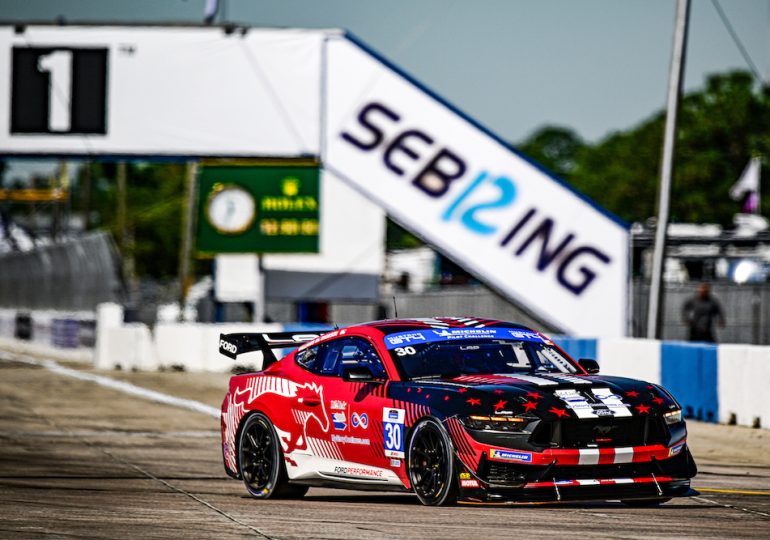
For fans of the Blue Oval, Saturday’s Sebring 12 Hours has the potential to be a memorable one. Ford Multimatic Motorsports has the potential to claim a second straight GTD Pro victory to kick off the 2025 IMSA Sports Car Championship season at the legendary endurance event. But that’s just a sliver of what’s on offer from the Mustang program in Florida. The entire race weekend will serve as a real-world showcase of the American brand’s approach to the business of motorsports.
Looking beyond the factory program in the headline championship, customer team Gradient Racing is working to take steps forward in the second outing for its Mustang GT3 in the GTD class of the 12 Hour. Five Mustang GT4s will fight for victory in the Michelin Pilot Challenge race on Friday while 21 Dark Horse R race cars are entered for the opening round of the second season of Mustang Challenge. Add it all up and you have a fleet of 29 track-only ‘Stangs scattered across the paddock.
This is the result of a huge push to emphasize the iconic V8-powered model’s sporting presence. Ford has created a ladder system that can take a driver from entry level all the way to the sharp edge of GT3 competition. Utilizing two new single-make series and the GT4 model – all the chassis having been – produced at the same Flat Rock Assembly Plant, the Ford program is unique in utilizing a single platform throughout its motorsport pyramid.
“Anytime anyone launches new race cars it’s a massive challenge and we’ve seen that, with the Mustang now and back in 2016 when we launched the GT,” Mark Rushbrook, the Ford Performance’s global director, told RACER ahead of Sebring. “Earning the GTD Pro class win in Daytona was a significant accomplishment and milestone for all of us and a reward for what we are trying to do. We are looking long-term, with the goal of winning with Mustang globally.
“We’re building GT3s, GT4s and Dark Horse Rs as fast as we can – we can’t build them fast enough for teams and drivers. We’ve had a lot of interest since we first announced the cars and started building them, and a win like Daytona only adds eyeballs and interest. My phone lights up with any race win, but after that win, it was one the biggest light-ups I’ve ever had.”
It’s still relatively early days for this ambitious project to build, sell and race Mustangs in multiple guises around the world, but the vision is crystal clear and the return on investment beyond the Rolex 24 triumph has already been impressive.
Domestically, up against brands such as Porsche, Lamborghini, Ferrari and Mazda with well-established single-make championships, there was no guarantee that Ford, even with the recognition and heritage of the Mustang, could carve out a place in the crowded marketplace and go beyond offering customers GT3 and GT4 products. Yet the numbers are already eye-opening. Fifty-five Dark Horse Rs have been built ahead of year two for Challenge, and a second series has been launched in reaction to demand.
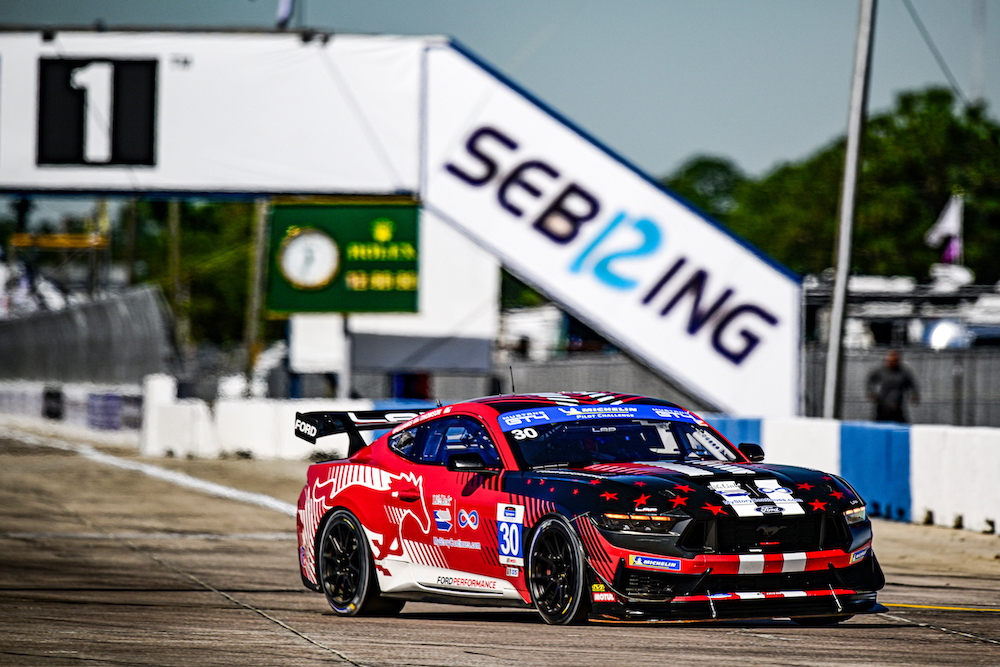 Mustang GT4s will be in the thick of the fight for Michelin Pilot Challenge honors at Sebring. IMSA Photo
So in just two years, interest from the grassroots level has been so strong that Ford has added the Mustang Cup to its portfolio. Sanctioned by USAC, Mustang Cup is aimed at newcomers to racing and serves as a new gateway to the sport for drivers who don’t have enough club racing experience under their belt to make them eligible for the IMSA-sanctioned Mustang Challenge.
“Deliveries were in Q1 (of 2024), and there were supply chain challenges, with some teams getting cars a week or two weeks before the first race,” said Scott Bartlett, Ford Performance global sports car marketing manager It was stressful but the one thing that was really impressive was we had no mechanical DNFs that first weekend, with a bunch of teams that had little to no prior running time with their cars.”
For 2025, the Dark Horse R race cars are improving too, with a new homologation. They’ve been updated with a (mandatory) kit that is being supplied to existing customers at cost. In a similar manner to its reaction to the Mustang GT3’s shortcomings last year, Ford has moved fast to make key tweaks to its single-make racer to ensure customers keep coming back for more. These include moving to an 18-inch tire size, and the addition of new rear camber arms.
Ford’s underlying goal is to provide customers with enough value for money at the bottom rungs of the ladder that they will set themselves out on a multi-year journey. A new Dark Horse R in 2025 will set you back $159,000 (including the update kit) and it can be used in either Cup or Challenge, depending on a driver’s ability level and/or preference; the only change needed aside from swapping tires between the two series (Michelin supplies Challenge and Yokohama supplies Cup), is a couple of minor decals on the car.
Drivers are also being given free open access to the Ford Performance Tech Center driver-in-the-loop simulator this year too, allowing them to improve their racecraft between events and prepare for some of the trickier circuits that the Dark Horse R race cars compete at.
“If you want to do both series you can, and we have a driver this year doing a full season of Cup and a few Challenge races,” said Bartlett. “It’s part of a big USP to what we are doing. It’s a ladder with the same chassis, and I don’t think there’s any other OEM using the same chassis from the one-make car to the top-make GT3. It’s a place you can start, and with Mustang Cup, we have a full system now.”
All this is already beginning to come together nicely and help aspiring racers climb the motorsport pyramid, as three drivers have graduated from Mustang Challenge to Pilot Challenge (Dark Horse R to Mustang GT4) after just a single year. Over time, this has the potential to give Ford both commercial and sporting benefits in equal measure. We’ve seen the likes of Nicklas Nielsen rise from racing in Ferrari Challenge to winning Le Mans overall in a 499P. Now, with a Hypercar program of its own on the horizon, Ford has put everything in place to tell a similar story in years to come.
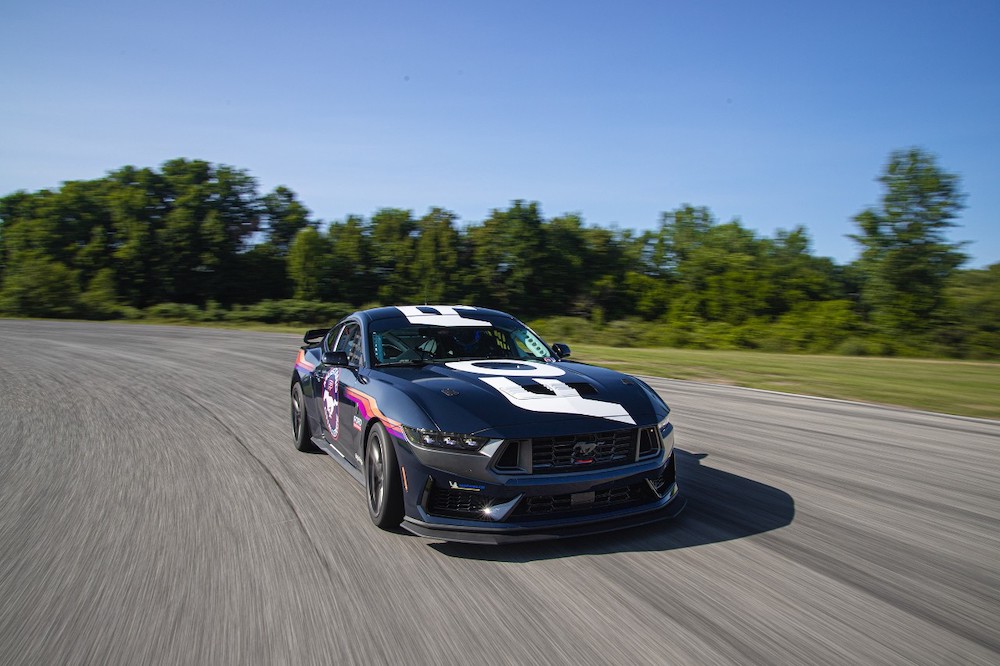 The Dark Horse R offers newcomers to racing an accessible entry point, and is eligible for both the Mustang Cup and – once the driver has gained a bit of experience – the IMSA-sanctioned Mustang Challenge. Image by Ford Racing
“We want to give a level for progression,” Bartlett said. “Sam Paley is a perfect example – his first time in a GT4 was Petit last year and he was 0.7 seconds off pole in his first time qualifying that car. He said that his previous racing in that platform, with a car that shares the same chassis dynamics, was so helpful.”
There are grander plans for the Mustang in GT competition across the world to look out for, too. Beyond an expansion to its customer base in GT3 and GT4, Dark Horse R will start to gain a foothold outside the U.S. starting in June, when the Mustang Challenge Invitational at Le Mans takes place. Between 30-35 Dark Horse R racers are expected to hit the track on the full Circuit de la Sarthe in France for two races held in the build-up to the 24 Hours, kickstarting an international expansion for Ford’s single-make push.
“It’s the right time to organize this, the series is new and there is a lot of excitement. We spent months working with the ACO and IMSA last year, because a lot of drivers are coming over from the U.S. and we are working on getting international drivers too,” Bartlett said when asked what competitors can expect from Ford’s Le Mans support races.
“We are working on the logistics, but I’d say that the majority of the Challenge drivers, 70-80 per cent from the IMSA paddock, are coming. We’ve created an attractive package where for $20,000 all-in we will fly your car round-trip and cover your entry fee. We’re going to charter a plane, or maybe two planes full of Mustangs, and I can’t wait to see that!
“The grid capacity is different from the target size, though. For us it’s about racers that are comfortable and safe, not just filling the grid with whoever we can get. We still have logistics to do in terms of handling cars for European racers, but a little more than half will be from the U.S. We’ll have a Mustang leading car, guest drivers I can’t talk about yet and a lot of activation around it.
“It’s the start of our aspiration to grow this. It’s not just a U.S.-only series that we plan on having, Dark Horse is global, so the series behind it needs to be global. And what better stage to promote that than Le Mans?
“We want to go across the Atlantic and across the Pacific in some cases. Jim Farley (Ford’s CEO) and Mark Rushbrook want to see growth in Mustang Challenge around the world in Australia, Europe, and wherever there’s demand. We need demand, infrastructure and partners. We are actively working on what a support network would look like in different markets.
“We’re working towards growth, because Dark Horse R will be going international for sure, beyond just Le Mans.”