
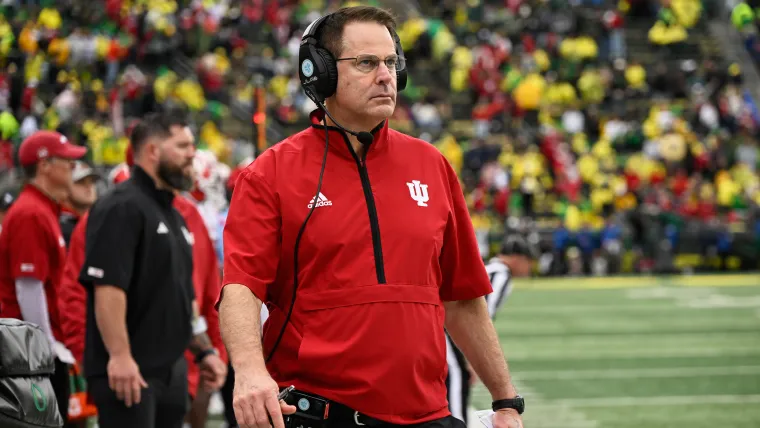
For the second consecutive season, Cignetti was named The Associated Press College Football Coach of the Year, a distinction that reflects more than wins, rankings or trophies.
The 64-year-old coach became the first to win the award in back-to-back years since it was introduced in 1998 and only the fourth to win it twice, joining Brian Kelly, Gary Patterson and Nick Saban.
Indiana is 13-0, the Big Ten champion for the first time since 1967, the No. 1 team in the AP Top 25 for the first time in program history, and the top seed in the College Football Playoff. The Hoosiers are led by quarterback Fernando Mendoza, the program’s first Heisman Trophy winner and the AP Player of the Year.
When Cignetti arrived from James Madison, Indiana carried the weight of an uncomfortable truth. In 2022, the Hoosiers became the first Bowl Subdivision program to reach 700 all-time losses. They entered this season with 714 — a total that still stands — and only recently ceded the dubious distinction of most losses in FBS history to Northwestern.
That history did not merely linger; it defined expectations. Indiana had never won more than nine games in a season. It had never completed a regular season undefeated. It had never been a national power. Cignetti did not promise incremental improvement. He delivered transformation.
Last season, Indiana won its first 10 games, climbed as high as No. 5 in the AP poll and reached the opening round of the College Football Playoff. This season erased any lingering doubts that the debut was a one-off.
Cignetti’s second Coach of the Year award was not close. He earned 47 of 52 first-place votes from a nationwide panel of media members who cover college football. Texas Tech’s Joey McGuire and Vanderbilt’s Clark Lea received two votes apiece, while Virginia’s Tony Elliott received one. The margin reflected consensus, not debate.
Perhaps most telling is that Indiana’s defining moment did not come quietly. Cignetti had acknowledged before the season that his program was still chasing Ohio State — on the field and on the recruiting trail. The Hoosiers closed that gap decisively with a 13-10 victory over the Buckeyes in the Big Ten championship game.
Afterward, Cignetti framed the moment not as an arrival, but as a checkpoint.
He spoke after the championship game about what the win represented for the program.
“It’s another step we need to take as a program,” Cignetti said. “It’s a great win, obviously. And we’re going to go in the playoffs as the No. 1 seed. And a lot of people probably thought that wasn’t possible. But when you get the right people and you have a plan and they love one another and play for one another and they commit, anything’s possible.”
That statement captures the essence of Cignetti’s tenure. Indiana’s rise has not been built on novelty or surprise, but on structure, conviction and sustained belief. The wins followed the culture, not the other way around.
For decades, Indiana football was defined by what it could not be. Under Curt Cignetti, it is now defined by what it expects, and increasingly, by what it achieves.